2025 UX Mentorship Insights
TL;DR I did 66 UX mentorship sessions and conducted an analysis of the topics that mentees discussed in our sessions.
What is this?
One of my goals this year was to increase my community contributions and provide mentorship to UXers. From speaking to 40 different designers & researchers from around the world, I saw a lot of commonalities. This project is about analyzing all of those conversations and uncovering insights and recommendations that I could share and help others with.
This year’s mentorship, part of Eliza-wrapped 2025 (yes, I know the map is wonky)
What did UXers talk about?
I took detailed notes in each of the 66 sessions and fed them into NotebookLM to conduct an analysis. I dug into the most commonly asked questions and topics as well as my most common feedback for UXers.
Node graph created with findings from notes from sessions and NotebookLM
60% of portfolio reviews required specific feedback on quantifying impact
Most mentees focused on the process (artifacts) rather than the outcome (metrics), prompting frequent references to the "Impact vs. Effort" matrix
20% of mentees discussed transitioning from a non-design background
These backgrounds included Forensic Science, Architecture, Music, Photography, Fashion, and Software Engineering
~25% of sessions involved deep discussions on AI integration
Mentees explored "Vibe Coding" for prototyping, using NotebookLM for research synthesis, and using LLMs to optimize resumes for keywords.
Common pieces of advice
Quantify Your Impact (The "So What?")
To make a portfolio compelling, always quantify your impact on the user, the company, and even team processes. This quantification should be integrated throughout your portfolio, defining the 'so what' of each project.
Define Critical User Journeys (CUJs) early in a project to set clear success measurements. The CUJ format, structured as "As a [user], I want to [goal], so I [task]," allows you to measure the completion rate of the task, which provides quantifiable results for your portfolio.
Prioritisation Through Impact and Effort
Using the Impact vs. Effort matrix is crucial both for defining project roadmaps and demonstrating strategic thinking during interviews. This approach helps you clearly define which initiatives are "Quick wins" (high impact, low effort) versus "Big projects" (high impact, high effort).
Impact vs. Effort matrix
Begin with the end
When presenting case studies or portfolios, start with the outcome or impact (the "end") before circling back to tell the full story of your process. This immediately captures the attention of busy hiring managers.
Preparing for interviews
Mentees spent a lot of time ensuring they were ready for the various rounds of UX interviews. This includes mock interviews, whiteboard exercises and prepping good questions to ask. This came up so frequently that I created a new section in my toolkit for Job Search.
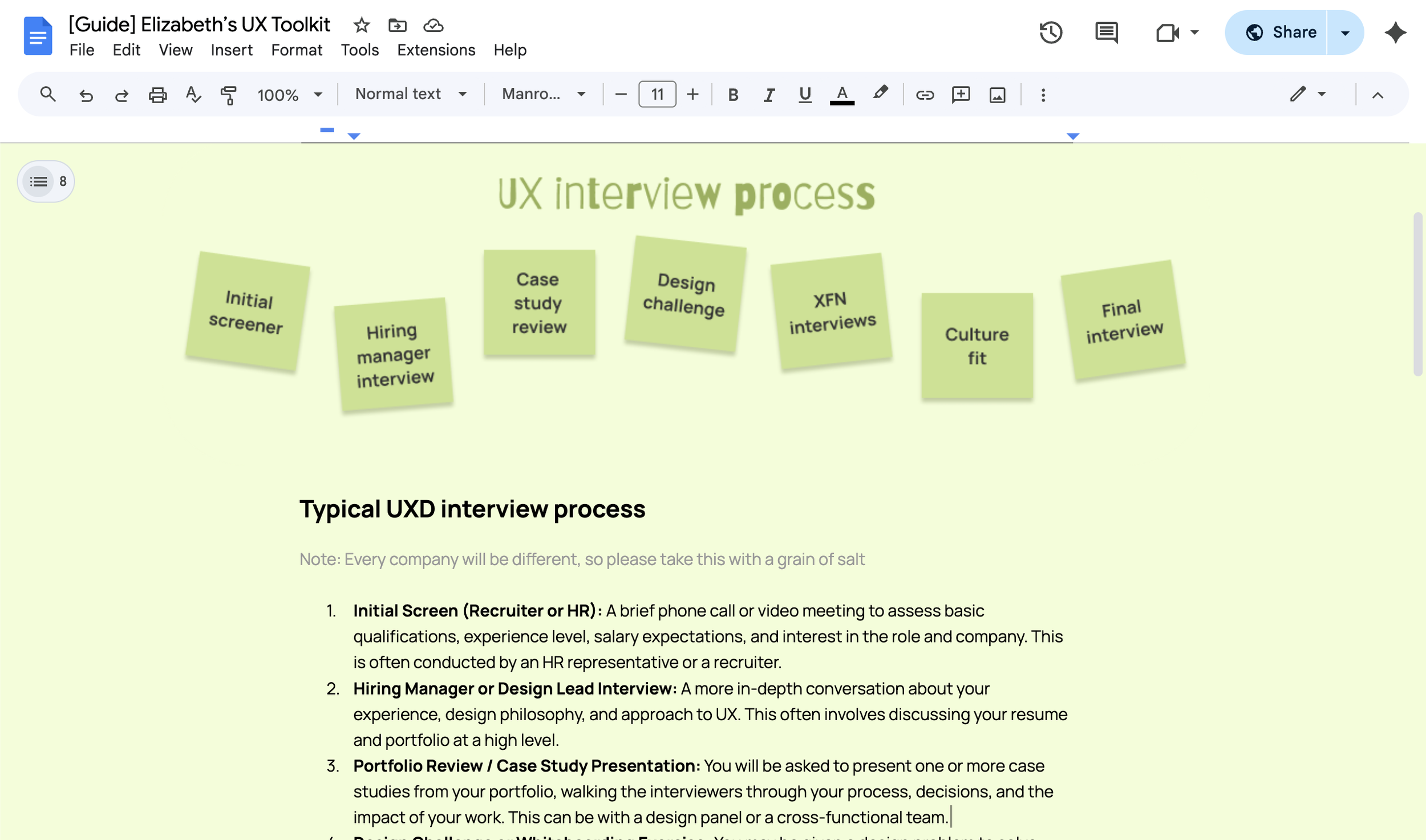
UX interview process within my UX Toolkit
Personal branding
To differentiate yourself in the job market, you should identify and specialize in a specific area of UX design, such as data visualization, accessibility, or tackling complex, "gnarly" B2B problems. Building this core craft is especially important when you are early in your career.
Career progression hinges on developing a clear personal brand—what are you good at, what do you enjoy, and what do you want to be known for? Designers should use structured activities to identify these defining adjectives, strengths, and vision for the next five years.
An example of personal branding from my website.
Master Articulating Design Decisions
Move beyond showcasing aesthetically pleasing screens by consistently explaining why you made specific design choices. This skill is essential for convincing stakeholders of the value of your work and forms a significant part of a Senior UX Designer's role.
Fidelity matters
To prevent stakeholders from jumping to conclusions and assuming a design is finished, utilize medium-fidelity wireframes that incorporate redacted text or placeholders. This technique helps focus conversations on interaction flows and concepts rather than UI specifics.
The amount of fidelity within your designs should reflect the stage of the design process you are in
How AI can fit into the double diamond
In November, I ran the AI in Enterprise UX Lightning Talk for the Tesco UX team that focuses on how you can integrate AI into the various parts of the double diamond. The intention is to use the tooling as a collaborator while you focus on the parts you still enjoy doing.
While AI is rapidly evolving, humans are still required to solve problems that haven't been solved before, as machines only perform well when they have relevant data. Use AI tools like NotebookLM or Gemini Canvas to handle time-consuming tasks, such as summarizing research transcripts or creating prioritization matrices, freeing you up to focus on novel problem-solving.
Lightning talk I did for Tesco UX team
AI projects as case studies
Many junior designers / interns are struggling to compete with the other candidates with scant portfolios with fake case studies from UX courses. I have been prompting many of my mentees to identify problems that they can solve with AI and to conduct a full case study, acting as PM, UX and ENG. An example that I have shown is the Question Generator tool that I created to solve a problem of coming up with interesting icebreakers for workshops.
My Question Generator app to spark conversations (read more in the blog post)
